The tiny clay figures that preserve the lost world of Silla.
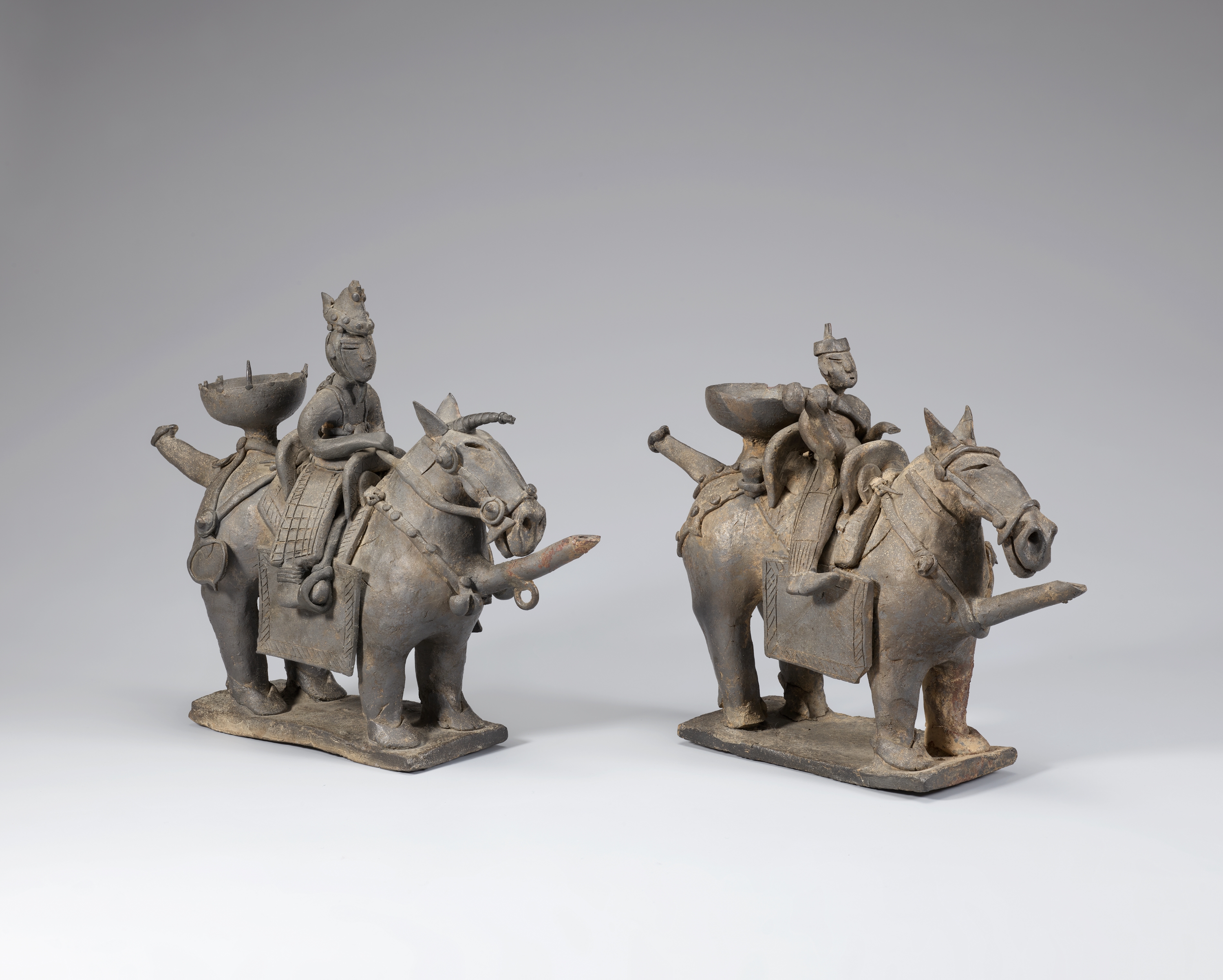 |
| Two mounted clay figures were buried together in Geumnyeongchong around fifteen centuries ago. They appear similar at first glance, but their clothing, equipment, posture, and roles are strikingly different. ⓒ National Museum of Korea |
Why Do These Two Riders Look So Different?
Most people smile when they first see them.
I did too.
At Gyeongju National Museum, two small riders sit on horseback as if they have just arrived from another world.
The figures displayed there are replicas. The originals are preserved at the National Museum of Korea in Seoul.
That distinction matters for photographs. The official images of the original objects reveal details that are difficult to see through a museum case.
But standing in front of the replicas in Gyeongju offered something the studio images could not.
A sense of scale.
They are small.
Much smaller than their fame suggests.
 | |
|
At first glance, they seem almost playful.
Two round horses.
Two expressive riders.
Something that could almost be mistaken for a toy.
Then the details begin to appear.
The horse has a bridle.
The rider carries a sword.
Small bells hang from the equipment.
The saddle has been modeled carefully.
Even the riders’ clothing is different.
The closer you look,
the more Silla begins to appear.
THE BIG QUESTION
Why did Silla artists make these two riders so different?
CONTENTS
- They Were Never Meant to Be Equal
- Looking Closely at the Master
- Looking Closely at the Attendant
- The Horse Is Just as Important
- A Vessel—or Something Else?
- 🌍 Around the Same Time...
- What Archaeologists Can Safely Say
- Two Riders, One Lost World
They Were Never Meant to Be Equal
 |
| The two figures are usually described as a master and an attendant. Their contrasting dress, equipment, and placement support that interpretation. ⓒ National Museum of Korea |
The two figures were discovered together among the burial goods of Geumnyeongchong.
They belonged to the same funerary arrangement.
But they were not made as equals.
One rider wears more elaborate clothing and carries a sword.
The other is more simply equipped and carries a bell.
Their horses also differ.
So do their positions.
Excavation records placed the simpler rider in front of the more richly dressed one.
That arrangement has led archaeologists to interpret the pair as an attendant leading a master.
They were buried as a pair.
Not as twins.
Not as equals.
No surviving Silla text explains who they were meant to represent.
They may depict real social roles.
They may also have carried symbolic meaning within the funeral.
What is clear is that their differences were intentional.
Looking Closely at the Master

His Hat
The master wears a distinctive hat secured beneath the chin.
From some angles, the fastening cord can resemble facial hair.
Seen clearly, however, it belongs to the headgear.
This tiny feature tells us something important.
The sculptor was not creating a generic rider.
He was recording a recognizable way of dressing.
His Face
The face is unusually individualized.
The nose is prominent.
The expression is calm and self-assured.
Some modern viewers describe the rider as foreign-looking.
That observation is understandable, but it must be handled carefully.
A stylized face is not proof of ethnicity.
Without an inscription or stronger supporting evidence, we cannot identify the rider as a specific foreign person or Central Asian individual.
What we can say is that the artist chose to make the master look visibly different from the attendant.

His Clothes and Sword
The master wears riding clothes suited to life on horseback.
A sword hangs beside him.
His body is upright.
His horse carries more elaborate equipment.
Nothing here looks accidental.
The visual message is rank.
This is not an ordinary traveler.
HIDDEN KOREA FIELD NOTE
The figure is often called “the master,” but that title is an archaeological interpretation based on visual hierarchy—not a name preserved from Silla.
Looking Closely at the Attendant
The attendant is more simply dressed.
He carries no visible sword.
Instead, he holds a bell.
That single object changes how we read the pair.
A bell could announce movement.
It could guide a procession.
It could also have had a ritual function.
Because the attendant was placed before the master, many scholars interpret him as leading the way.
Perhaps he guided the master in life.
Perhaps he was imagined guiding him after death.
That second idea is plausible, but it remains interpretation.
No written explanation survives.
One rider carries a sword.
The other carries a bell.
The contrast may represent more than occupation.
It may encode the relationship between command and service, status and duty, the living court and the imagined journey beyond the tomb.
The Horse Is Just as Important
It is easy to focus on the riders.
But the horses preserve just as much information.
They are not fantasy animals.
Their equipment reflects a real culture of riding.
This Is Not a Horn

The upright form on the horse’s head can look like a horn.
It is the mane, gathered and tied upward.
The artist considered even the grooming of the animal worth recording.
A Real Bridle
The mouth is fitted with a bit.
Lines along the head represent the bridle.
This was a horse imagined under human control.
The detail also gives archaeologists visual evidence to compare with metal horse gear recovered from Silla tombs.
The Saddle
The saddle rises at the front and rear.
Its form resembles actual saddle components discovered in elite Silla burials.
The rider sits securely between them.
Even at this small scale, the relationship between rider, saddle, and horse is convincing.
Stirrups
The rider’s feet rest in stirrups.
They are tiny.
But they are unmistakable.
Stirrups gave mounted riders greater stability and control.
Their presence places these figures within the wider development of cavalry culture across late ancient Eurasia.
Ornaments and Side Coverings
Decorative fittings hang from the harness.
Other modeled forms resemble protective or ornamental side coverings associated with elite horses.
Such equipment also appears in archaeological finds from Silla tombs.
The famous painting from Cheonmachong belongs to this broader world of richly decorated horse gear.
That does not mean every detail on these clay horses can be matched perfectly to one surviving object.
It means the figures preserve a visual language recognizable from Silla’s elite equestrian culture.
These horses are not decoration around the story.
They are part of the evidence.
A Vessel—or Something Else?
The figures are hollow.
An opening on the back allows liquid to enter.
Another opening projects from the horse’s chest.
For this reason, the objects have traditionally been interpreted as ceremonial vessels, often described as ewers.
Their capacity is small.
They were probably not everyday containers.
If liquid was used, it may have been part of a burial rite, offering, or symbolic act.
But the interpretation is not completely settled.
Some researchers have questioned whether the chest opening would have functioned conveniently as a pouring spout.
Other possible uses, including a lamp function, have been proposed.
No single explanation answers every detail beyond doubt.
“Ceremonial vessel” is the traditional interpretation.
Its exact ritual use remains debated.
That uncertainty does not weaken the objects.
It makes them more interesting.
They are both images and containers.
Portraits of hierarchy and functional objects.
Miniature riders and archaeological puzzles.
🌍 Around the Same Time...
In the fifth and early sixth centuries, mounted warfare and elite horse culture shaped societies across Eurasia.
In northern China, powerful cavalry traditions influenced the Northern Wei state, while tomb art recorded riders, horses, processions, and military rank. Farther west, the Sasanian Empire celebrated elite horsemen in royal art and controlled networks connecting Iran with Central Asia.
Silla’s mounted figures do not prove direct contact with every one of these civilizations. They do show that the kingdom belonged to a wider age in which horses represented mobility, military power, rank, and prestige.
What Archaeologists Can Safely Say
CONFIRMED
- The two mounted clay figures were excavated from Geumnyeongchong.
- They were discovered together among the burial goods.
- The figures are hollow and contain openings associated with liquid or another functional use.
- The riders and horses display different clothing, equipment, and ornament.
- The horses preserve modeled details of Silla riding equipment, including bridles, saddles, and stirrups.
STRONG INTERPRETATION
- The more richly equipped rider represents a master or elite figure.
- The simpler rider carrying a bell represents an attendant.
- The attendant’s position suggests that he was leading or guiding the master.
- The objects were probably made for funerary or ceremonial use rather than everyday life.
STILL DEBATED OR UNKNOWN
- Whether the riders depict real individuals or symbolic social roles
- The exact ritual meaning of the bell
- Whether the objects functioned primarily as ewers, lamps, or something else
- Whether the master’s distinctive face was intended to represent a foreign individual, an artistic convention, or an elite ideal
Two Riders, One Lost World
The longer we look, the less these figures resemble toys.
They preserve horses.
Clothing.
Weapons.
Rank.
Craftsmanship.
And perhaps a belief that the relationships of life continued beyond death.
One rider leads.
One follows.
One carries a bell.
One carries a sword.
Together, they transform a small clay object into a surviving scene from Silla society.
 |
| Seen in the museum gallery, the figures appear small and almost approachable. Their scale makes the precision of their details even more remarkable. Photograph by the author. |
Yet one mystery remains difficult to ignore.
The master does not look quite like the attendant.
His face is different.
His posture is different.
His entire visual identity sets him apart.
Was this simply a way to show social rank?
Was it an artistic choice?
Or did Silla artists sometimes associate elite warriors with faces and fashions that looked beyond the Korean Peninsula?
Centuries later, stone guardians with similarly unfamiliar features would stand before a royal Silla tomb.
The two clay riders have answered one question.
They have opened another.
HIDDEN KOREA
Two riders preserved
a lost world of Silla.
One face points toward
the next mystery.
FAQ
Where were the horse-rider-shaped pottery figures found?
They were excavated from Geumnyeongchong, a Silla royal tomb in Gyeongju, during the 1924 investigation of the mound.
Are the figures at Gyeongju National Museum original?
The originals are preserved at the National Museum of Korea in Seoul. Gyeongju National Museum displays replicas that allow visitors to encounter the figures close to the place where they were discovered.
Who are the two riders?
They are usually interpreted as a master and an attendant because of their contrasting clothing, equipment, and placement. Their real identities are unknown.
Why does the attendant carry a bell?
The bell may indicate that the attendant led a procession or guided the master, possibly within a funerary journey. No surviving text confirms its exact meaning.
Were the figures used as ewers?
They are traditionally interpreted as ceremonial liquid vessels because they are hollow and have openings. Other functions, including use as lamps, have also been proposed, so their exact ritual purpose remains debated.
Was the master a foreigner?
There is no evidence strong enough to identify him as a specific foreign person. His distinctive facial features may reflect artistic style, elite identity, or wider cultural influences, but the question remains open.
NEXT EXPEDITION
The Foreign Faces Guarding a Silla King
Centuries after the clay riders were buried, stone warriors with unfamiliar faces appeared before a royal tomb in Gyeongju.
Were they foreigners, symbols of distant power, or ideal guardians created by Silla artists?
Continue to Expedition 014 →Image Notes
Hero and detail images: use high-resolution photographs of the original objects from the National Museum of Korea whenever reuse conditions permit.
Gyeongju field photographs: use one image near the introduction and one near the reflection to provide scale and on-site atmosphere. Clearly identify the displayed objects as replicas.
Do not crop, annotate, recolor, combine, or otherwise modify museum images when the stated license prohibits derivative use.
Recommended museum credit format: “Source: National Museum of Korea.” Add the exact license type and attribution wording required by the image source.
Further Reading
- National Museum of Korea, materials on the horse-rider-shaped pottery vessels from Geumnyeongchong.
- Yun Sang-deok, “Horse-Rider-Shaped Pottery: A Ewer of the Silla Royal Court.”
- Gyeongju National Museum materials on Geumnyeongchong and Silla royal tomb culture.
- Published archaeological reports and reassessments of Geumnyeongchong.
- Research on Silla horse gear, saddles, stirrups, and funerary ritual.
