HIDDEN KOREA · SILK ROAD TO GYEONGJU · EXPEDITION 019
Why Does Silla Look So Different?
One strange object is a curiosity.
But what happens when the clues keep appearing?
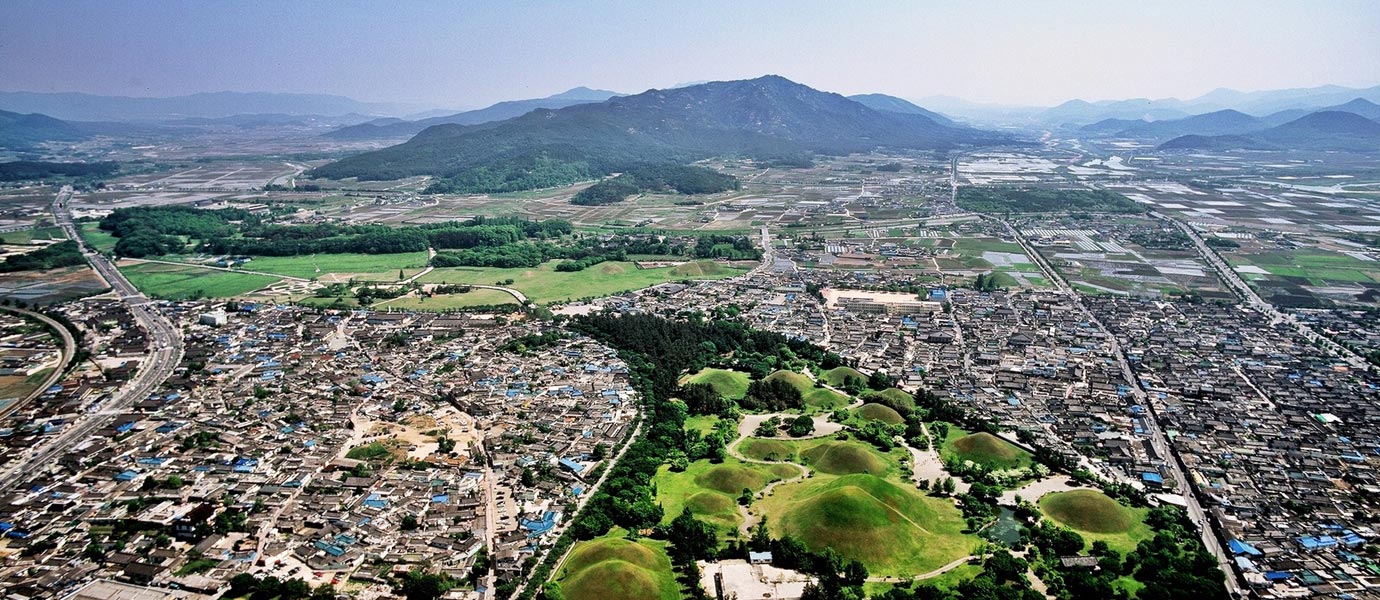 |
Photograph by gyeongju city. |
A glass vessel that had traveled across Eurasia.
A jeweled dagger unlike ordinary Korean weapons.
Elaborate horse equipment buried with the elite.
Royal tombs built in a form unlike those of neighboring Korean kingdoms.
Gold crowns with branching and antler-like shapes.
A foreign-looking warrior standing beside a Silla king.
And finally, a broken royal inscription preserving a memory connected to the Xiongnu world.
Each clue has its own explanation.
Each can be studied separately.
And historians are right to be careful.
But after eighteen Expeditions, I found myself facing a different question.
What happens when we stop looking at each clue separately—and place them all on the same table?
CONTENTS
- One Mystery Is Easy to Ignore
- The Objects That Traveled
- The Horse and the Tomb
- The Gold
- Then a Human Face Appeared
- And Finally, Words
- Trade—or People?
- 🌍 Around the Same Time...
- What Can We Actually Say?
- The Question I Want to Leave With Historians
One Mystery Is Easy to Ignore
One unusual artifact proves very little.
A foreign object might have arrived as a gift.
It might have passed through several merchants.
It might have been captured in war.
It might simply have been an extraordinary luxury owned by an extraordinary person.
That is why one Roman glass vessel in a Silla tomb does not prove that Romans came to Gyeongju.
One Central Asian-looking decoration does not prove migration.
One unusual tomb does not prove ancestry.
This is basic historical caution.
But historical caution should not prevent another kind of question.
What if unusual things keep appearing in the same place?
The Objects That Traveled
Early in this journey, I became fascinated by objects that seemed to have traveled impossible distances.
Glass from western Eurasian traditions reached the royal tombs of Gyeongju.
A magnificent jeweled dagger from Gyerim-ro carried a decorative language that points far beyond East Asia.
These objects taught us something important.
Ancient Korea was not sealed off at the eastern edge of the continent.
Goods could travel astonishing distances.
Not necessarily in one journey.
Not necessarily with one merchant.
But through networks connecting one society to another.
 |
| This jeweled dagger, excavated from a Silla tomb in Gyeongju, is one of several luxury objects that point toward connections far beyond the Korean Peninsula. |
At first, that seemed to be the story.
Trade.
Then the horses appeared.
The Horse and the Tomb
Silla's elite graves contained sophisticated horse equipment.
Bits.
Stirrups.
Saddles.
Harness ornaments.
Bells.
Decorated fittings.
The horse was clearly more than transportation.
It belonged to the visual and political world of Silla's elite.
Then there were the tombs themselves.
The great stone-mound wooden-chamber tombs of early Silla formed a burial tradition strikingly different from the better-known stone chambers of neighboring Korean kingdoms.
Researchers have long compared elements of these graves and Silla horse culture with traditions farther north across Eurasia.
Comparison does not prove origin.
But it widens the map.
First the objects had traveled.
Then the cultural parallels began pointing north.
The Gold
And then there was gold.
Gyeongju produced an extraordinary concentration of gold crowns and elite ornaments.
The crowns were not merely expensive.
They had a distinctive visual language.
Branching uprights.
Antler-like forms.
Curved jade ornaments.
Thin gold pieces designed to shimmer and move.
Some comparisons point toward wider traditions of northern and Central Eurasia.
Again, resemblance is not ancestry.
But by this stage, I was no longer looking at one imported cup.
I was looking at a repeated series of questions.
 |
Then a Human Face Appeared
Objects can travel without people traveling the entire distance.
That fact matters.
A glass vessel does not prove the presence of a Roman merchant in Silla.
But at the royal tomb generally identified with King Wonseong, the mystery changed.
Standing beside the ceremonial approach is a stone warrior whose face looks strikingly different from the nearby Silla civil official.
Korean heritage descriptions have long characterized the figure as Western-looking or associated with people of the Western Regions.
Scholars debate exactly what the image represents and how its visual type reached Silla.
But to me, it opened a very simple question.
If objects could travel this far,
what about people?
 |
And Finally, Words
Then came the broken stone.
The Monument of King Munmu.
This changed the question again.
Until then, we had been interpreting objects.
Now Silla itself had left words.
The surviving and reconstructed genealogical language of the monument includes the title “Marquis of Du” and the mysterious King Seonghan.
The title has long been connected in historical discussion with Jin Midi—Kim Il-je in Korean—a man from the Xiongnu world who rose to prominence at the Han imperial court.
A KBS historical documentary followed that clue much further.
It explored whether the Kim rulers of Silla might have preserved a memory of ancestry connected to the Xiongnu world.
The program also brought together political change, tombs, gold, horse culture, ancient records, and possible migration.
The reconstruction remains a hypothesis.
But suddenly the question was no longer coming only from modern comparisons of artifacts.
A Silla royal genealogy itself had entered the conversation.
 |
Trade—or People?
This is where I think the question becomes worth asking openly.
Perhaps all of these connections can be explained primarily through exchange.
Objects moved.
Techniques moved.
Styles moved.
Political symbols moved.
That would already make Silla far more connected to Eurasian history than many people imagine.
But ancient networks did not move only objects.
Merchants moved.
Envoys moved.
Craftsmen moved.
Soldiers moved.
Refugees moved.
Families moved.
Whole political communities sometimes moved.
So after seeing the same wider Eurasian horizon appear again and again around Silla, I think another question is legitimate.
THE QUESTION
Were we looking only at long-distance exchange?
Or are some of these clues also traces of people who moved?
I do not know the answer.
That is not false modesty.
I really do not know.
I am a pastor living in Gyeongju, not an archaeologist reconstructing ancient population movements.
But this entire project began because I stopped beside a stone turtle and asked a question that seemed too small to matter.
I have learned not to be embarrassed by questions simply because I cannot yet answer them.
🌍 Around the Same Time...
Across late antiquity, Eurasia was a world of movement.
Roman and later Byzantine networks connected the Mediterranean with western Asia. Sasanian Persia stood between the Mediterranean, Central Asia, and the Indian Ocean. Steppe confederations repeatedly transformed the political landscape of northern Eurasia, while merchants and envoys moved between Central Asia and China.
Farther east, the kingdoms of the Korean Peninsula interacted intensively with China and Japan while also receiving objects and influences that had traveled much farther.
The important point is not that Silla had direct relations with every one of these civilizations. It is that Silla developed inside the same moving Eurasian world—not outside it.
What Can We Actually Say?
CONFIRMED
- Long-distance luxury goods reached elite Silla tombs in Gyeongju.
- Silla horse equipment and burial culture have been compared with wider northern Eurasian traditions.
- Silla developed a distinctive concentration of gold regalia and elite material culture.
- Foreign-looking human imagery appears in Silla royal funerary sculpture.
- The Monument of King Munmu preserves unusual royal genealogical language that has generated debate about Jin Midi and the Xiongnu world.
REASONABLE TO INVESTIGATE
Silla's formation and elite culture should be examined not only within the Korean Peninsula, but within wider networks of Eurasian mobility, exchange, and political change.
NOT PROVEN
That all of these clues have one origin, that a single migration explains early Silla, or that archaeological similarity by itself proves Xiongnu ancestry.
Those limits matter.
But limits are not the same thing as a command to stop looking.
The Question I Want to Leave With Historians
I began this series knowing almost none of this.
I simply kept asking why.
Why was this glass here?
Why did this dagger look so different?
Why so much horse equipment?
Why were these tombs built this way?
Why did these crowns take this shape?
Why did this stone warrior look unlike the man standing behind him?
Why did a Silla royal monument remember the Marquis of Du?
Perhaps specialists have good answers to each question separately.
I hope they do.
But after placing the clues together, there is one question I would like to hand back to them.
How much movement of people would it take
before ancient Silla began to look like this?
Maybe the answer is very little.
Maybe it is much more than we have usually imagined.
That is for archaeology, history, genetics, linguistics, and future discoveries to test.
For me, something simpler has already changed.
I can no longer see Gyeongju as a distant corner of the ancient world.
Too many roads seem to meet here.
Perhaps the question is not:
“How did foreign things reach Silla?”
Perhaps the larger question is:
“What kind of kingdom was Silla becoming at the meeting point of all these movements?”
One Road Is About to End
We began Season One following the Silk Road toward Gyeongju.
We followed glass.
Gold.
Weapons.
Horses.
Tombs.
People.
And finally, memory.
But a road does not become interesting only because of where it ends.
Sometimes the most important discovery is another road leaving from the same place.
Until now, we have looked mostly west and north.
For the final Expedition, we turn south.
NEXT · SEASON 1 FINALE
What If Another Road Reached Korea from the South?
So far, the trail has taken us across the Eurasian continent.
But ancient Korea also faced the sea.
And on Korea's southern coast survives another strange memory:
a foreign princess, a distant kingdom, and a journey to Gaya.
Expedition 020 · Season One Finale
FAQ
Does this prove that Silla came from the Xiongnu?
No. Several clues have been compared with northern Eurasian traditions, and the Monument of King Munmu has generated a specific genealogical debate. That is not the same as proving a single ethnic origin for Silla.
Could trade alone explain the foreign objects in Silla?
Trade and diplomatic exchange can explain the movement of many objects over great distances. The larger question is whether archaeological, historical, and artistic evidence also preserves traces of human mobility.
Why put all these clues together if they may have different explanations?
Not to claim that they all share one cause, but to ask whether examining them together reveals larger patterns that are less visible when every object is studied in isolation.
Is Hidden Korea proposing a new historical theory?
No. Hidden Korea is following existing artifacts, records, scholarly debates, and previously proposed hypotheses, then asking where the evidence may lead next.
Image Notes
All photographs credited to the author were taken in Gyeongju. Previously introduced objects are reused here only where they help bring the Season One evidence together.
Further Reading
- National Museum of Korea and Gyeongju National Museum materials on Silla archaeology and long-distance exchange.
- Research on Silla stone-mound wooden-chamber tombs and northern Eurasian burial comparisons.
- Research on Silla horse equipment and Eurasian mounted cultures.
- Studies of the Monument of King Munmu, King Seonghan, the Marquis of Du, and Silla royal genealogy.
